

Get your evenings back. One screen, pulled when you open it.
TruLata takes the checking and the scheduled work off your evenings and leaves the approval settings with you. This page shows the split, and what it costs on the published tiers.

Why does one question take five logins?
One question takes five consoles. Google Analytics says whether traffic moved. Google Ads says what the week cost. Search Console says whether the new page has impressions yet. Your Business Profile says whether the last review was answered. Your CRM says which of last week's enquiries became a quote. Five logins, five date pickers and more than one definition of a conversion. The question you actually have, which channel produced the jobs that paid, is in none of them. It sits between them, and you do the joining by hand, late, from memory.
That is not a failure. It is the default when you sell a service and the marketing sits on top of another job, so the joining falls to whoever is still at the desk at 9pm. TruLata takes part of that evening and leaves part with you. Here is the split.
One question, five consoles
- Google Analytics
- Google Ads
- Search Console
- Business Profile
- Your CRM
- Five logins, five date pickers
- Joined by hand, late, from memory
The question you actually have, which channel produced the jobs that paid, is in none of them.
Which tabs can I close tonight?
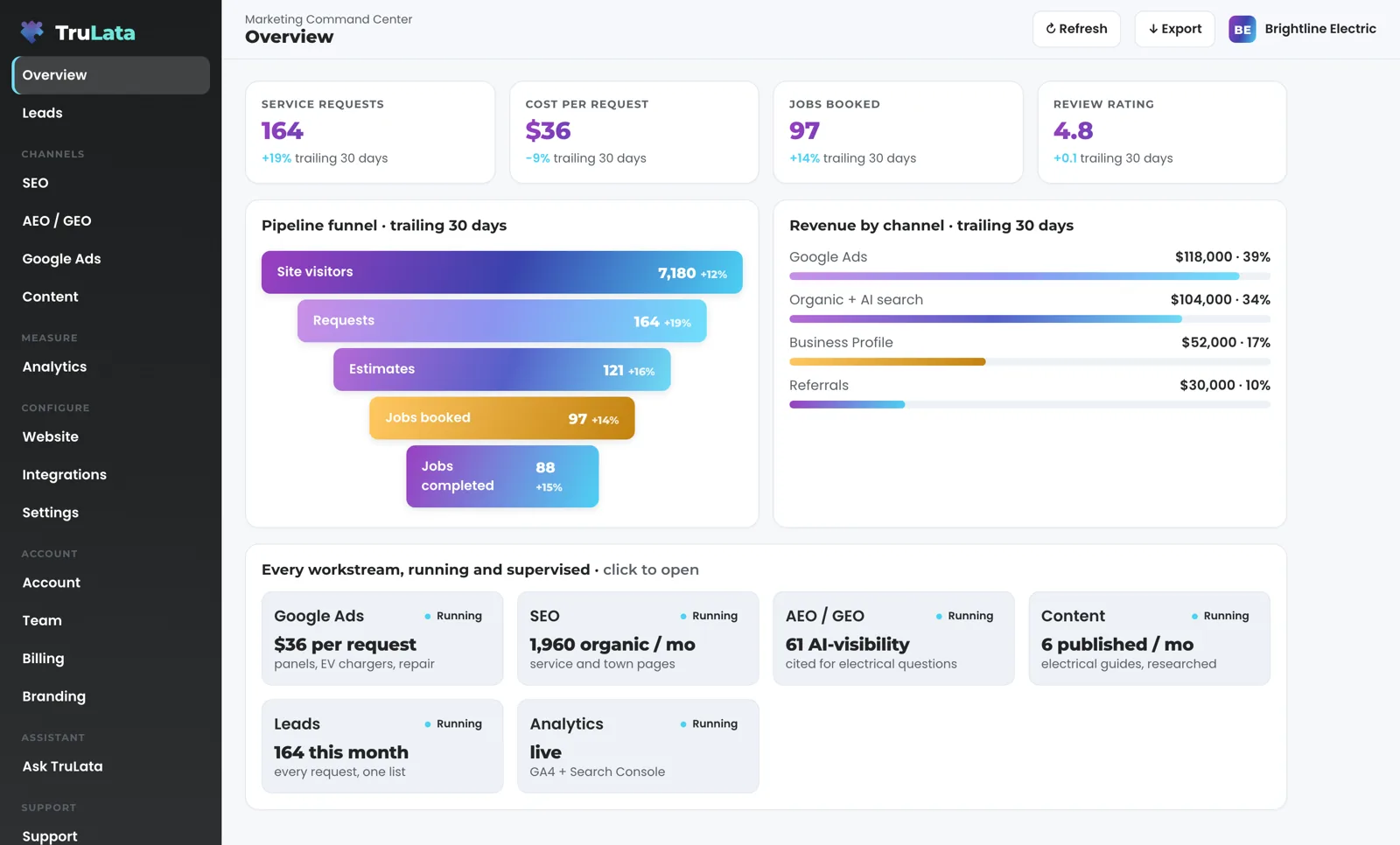
All five, for checking. Your instance is one dashboard at your own address on trulata.com, behind your own login. The Overview holds the headline numbers, the pipeline funnel, revenue by channel where your revenue is mapped to channels, and one tile per workstream. Each view reads its own source: Analytics for sessions, sources, pages and key events; Search Console for queries, clicks and average position; Google Ads for spend, conversions and cost per conversion; your Business Profile for reviews, rating and listing performance; your CRM, for pipeline stages and sources; Stripe for payments; your CRM or booking platform for jobs where your business runs on it. Click a headline number and it opens to its value, change and window. Other figures open to a detail panel.
It refreshes because you opened it. The page shows last night's snapshot in the first instant, fetches the live payload from cache, and runs a pull behind the page if that is older than five minutes. The header stamp says when the data was pulled. Press Refresh and a full pull runs, two seconds to a little over three minutes, and the page reloads when the stamp moves. You never see an error: if the live service cannot be reached, you read last night's numbers and the stamp says so. Each source sets its own ceiling. Your CRM, Stripe, your booking platform, website leads and email statistics are live. Google Ads and GA4 lag by hours. Search Console runs two to three days behind.
What gets done while I am on a job?
The scheduled work, the part that waits for your evenings. Where the outbound engine runs, it sources prospects weekly to a target profile agreed with you, finds a deliverable address or routes the prospect to a contact-form path, and parks each draft in a review-first queue. Replies are classified and shown, and not-interested or bounced addresses are suppressed from further sends. Where the content engine runs, each topic passes a demand gate on real search volume and how occupied the results already are; the engine researches from current sources, writes, and files the piece as a Google Doc in a Drive folder kept for your business, with a generated featured image. Where we manage your Google Ads search, a change watch reads the account every morning. Answer-engine visibility is scored across ChatGPT, Gemini, Claude and Grok at baseline and re-run as the program moves.
Two watches run each morning, each on the accounts it is set up against. At 7:05 Eastern the ads change watch reads your account's change history and sorts it into our own writes, routine noise and material changes made by anyone else, including recommendations Google applied on its own. It reads the account's user list directly, because a change of access is never logged as a change. A material change made by anyone else reaches your team that same day, so a setting switched on under any login, or a new address given access overnight, is known the next morning. At 7:20 Eastern, on an instance where the lead watch is set up against your forms, five checks run across your site's tag, Ads and GA4, so a broken tag is raised the next morning instead of reporting zero for weeks.
While you are on a job
- Ads change watchour writes, routine noise and material changes, sorted
- Lead watchfive checks across your tag, Ads and GA4
- Prospect sourcingparked in a review-first queue, where outbound runs
- Contentdemand-gated, filed as a Google Doc
- Answer enginesscored at baseline, then re-run

Two watches run each morning.
What stays my decision?
Approvals and outcomes. Prospect emails leave from a review-first queue; a person releases them, or the queue releases on the schedule set for the engagement, and every send is logged. Content approval is optional and auto-publish is a per-client setting: a piece waits for you or goes out on the cadence you chose, and you pick which. When a lead lands, you set its outcome from the screen and it is written to the lead record. A phone lead counts only if your CRM records it.
Changes to your accounts are on the record. From the screen you ask for a website change or a content, keyword, category or targeting change; each request goes to the team and is logged. A request from the screen goes to your team as a logged ticket; the engine's writes to your ad accounts and your site go through their APIs and land in each account's own change history. Google connections are manager invitations you send from your own console, and you revoke them there. We never ask for your account passwords. You get the checking back. The judgement stays with you.
Your evenings, before
- Five logins, five date pickers
- The joining, done by hand
- Each console checked in turn
What stays your decision
- Releasing prospect emails, or the schedule that does
- Content approval, your setting
- Lead outcomes, set from the screen
- Manager access, granted and revoked by you
How soon can I close the tabs?
First you add our Google account as a manager on your Analytics property, your Search Console site, your Ads account and your Business Profile, and our team connects your CRM, Stripe, your booking platform, your email platform, and your website forms from the inside, with access you grant. The manager invitations are enough, and you keep every password. Then the first pull fills the Overview, the answer-engine baseline runs, the keyword set is agreed and the ads watch starts on your account. After that the content cadence, the ads reports, the email flows and the program goals are set.
Each view arrives as its source connects, and the Jobs view shows a coming-soon card until its data can be trusted. What we need from you at each step is on the setup page.
- AccessAdd our Google account as a manager; our team connects your CRM, Stripe and forms
- First pullThe Overview fills, baselines run, the keyword set is agreed, the ads watch starts
- RunningContent cadence, ads reports, email flows and goals are set
- Each view as its source connectsJobs shows a coming-soon card until its data can be trusted
What do I pay, and what do I get?
Doing it yourself costs evenings, and we put no invented number on an evening. Here is our side. Starter is $400 a month, Launch $650, Growth $1,200, and Command is scoped per engagement. Starter carries the TruLata dashboard, full analytics, leads, search visibility, the AI visibility program, managed Google Ads search, the assistant and briefings and support tickets; Launch adds the content engine; Growth adds Meta ads; Command adds the outbound engine, social media management and your full marketing team, always on. Seats are three on Starter, three on Launch, ten on Growth and unlimited on Command.
Every tier is month to month and nothing inside it is metered. An annual commitment takes 20 percent off the monthly. A managed strategy retainer, scoped with you, sits on top of any tier. If you stop, you revoke our manager access in your own consoles. The full table is on the pricing page.

Who does the job, side by side.
| The job | Doing it yourself | With TruLata |
|---|---|---|
| Checking the numbers | Five consoles, five logins, five date pickers | One screen; headline numbers open to their value, change and window |
| Freshness | As of whenever you last looked | Pulled when you open it; the header stamp says when |
| Ads account changes | Yours to notice | Change history read daily at 7:05am ET; material changes raised the same morning |
| Lead counting | Whatever the ad platform reports | Counted from your own forms, server-side; checked daily against Ads and GA4 where the forms feed the sheet |
| Prospecting | Yours to do, when there is time | Sourced weekly to your target profile; every send from a review-first queue, logged |
| Content | Yours to write, when there is time | Demand-gated, drafted, filed as a Google Doc; approval optional |
| Answer engines | Yours to check by hand | ChatGPT, Gemini, Claude and Grok scored at baseline, re-run as the program moves |
| Changes to your accounts | Made by you | Requested from the screen, logged, made by the team |
A request from the screen goes to your team as a logged ticket, and the engine's writes to your ad accounts and your site go through their APIs and land in each account's own change history. Every change is on the record.
Questions, answered.
Do I still have to log into Google Analytics and Google Ads?
Not to check the numbers. Each view reads its source through the access you granted, and headline numbers open to their value, change and window. Your consoles stay yours, and every change lands in their own change history.
Does it change anything in my accounts on its own?
Within the limits you set. The screen sets a lead outcome and sends requests to the team as logged tickets; the engine's writes to your ad accounts and your site go through their APIs, stay within the limits set for your engagement, and land in each account's own change history.
Does it send emails or publish without me?
Only if you chose that. Prospect emails leave from a review-first queue; a person releases them, or the queue releases on the schedule set for the engagement, and every send is logged. Content approval is optional and auto-publish is a per-client setting, so a piece goes out without you only on the cadence you chose.
How fresh is what I see?
Live for your CRM, Stripe, your booking platform, website leads and email statistics. Google Ads and GA4 lag by hours; Search Console runs two to three days behind. The header stamp says when the data was pulled.
What does it cost?
Starter is $400 a month, Launch $650, Growth $1,200, and Command is scoped per engagement. Every tier is month to month with nothing metered.
See it running
before you decide.
The demo is the real product on a fictional company, with your name and email in front of it. Pricing is three published tiers.
Open the live demo See pricing
New here? See what TruLata is. Prefer to write? Send us the one thing you want to know.
Start here: AI marketing platform · AI marketing software · all-in-one marketing platform · marketing automation software · marketing software for small business.
- Refreshed when you open itLive data on page load, never a monthly PDF
- Counted from your own formsLeads recorded server-side, compared daily with Ads and GA4
- Seen in AI answersHow often ChatGPT, Gemini, Claude and Grok name you, measured
- Every send loggedProspect emails leave from a review-first queue, and every send is logged.