

Hire for judgement. Put the watching on a schedule.
A person brings judgement and relationships. TruLata takes the work that has to run on a clock: the ads change watch at 7:05am Eastern every day, a lead ledger that counts every form submission where your forms feed it, and four answer engines asked the same questions the same way.

What should I hire a person for?
Judgement and relationships. A good hire knows which customer deserves an hour of your time, which vendor is padding the invoice, and which of your ideas should wait a quarter. They sit in the room. They hear the tone of a complaint and know what it means for next month. The screen holds the record; the person holds the judgement, and this page keeps the two apart.
One person cannot give you coverage. A hire works a working week with one set of eyes and reads reports someone else assembled. On holiday, the account goes unwatched. When they leave, most of what they knew leaves with them. Decide what the person should do, and what should run whether or not anyone remembers to check.
One hire, alone
- Both kinds of work, in a working week
- One set of eyes on every channel
- On holiday, the account goes unwatched
- Most of what they knew leaves with them
A hire, plus the schedule
- The person holds the judgement
- The screen holds the record
- The watching runs whether anyone remembers
What runs without me remembering to check?
Prospect sourcing runs weekly. On Command, the outbound engine sources prospects to your target profile, enriches each to a deliverable address or routes it to a contact-form path, and drafts the message. Prospect emails leave from a review-first queue; a person releases them, or the queue releases on the schedule set for the engagement, and every send is logged. The ads change watch runs at 7:05am Eastern every day. It reads the change history of every Ads account mapped to a client, separates our own writes and routine noise from material changes made by anyone else, and reads the account user list directly, because a change to who has access never logs as a change event. The lead watch runs at 7:20am Eastern. Where your website forms feed the lead ledger, it runs five checks across that ledger, GA4 and Google Ads.
Every night at 12:01am Central, one registry bakes a fallback snapshot for every client. A failed pull leaves the previous page up, so there is always a complete page to open. Open the dashboard and the page loads that snapshot first, then pulls live numbers behind the request when the snapshot is older than five minutes. A hire can do any one of these on a good day. The system runs each of them on its own schedule, whether anyone is at a desk.
What runs, and when
- Prospect sourcingreview-first, on Command
- Ads change watchchange history and the account user list
- Lead watchfive checks, where your forms feed the ledger
- Fallback snapshota complete page to open, every night
- Live pullwhen the snapshot is older than five minutes

The system runs each of them on its own schedule, whether anyone is at a desk.
What gets caught that one person would miss?
See whether the answer engines name you. Being found now includes whether ChatGPT, Gemini, Claude or Grok names your business when a buyer asks. TruLata asks each engine the same bare question set through its own API with web search on, and scores the answers. A blank answer counts as a measurement error and leaves the denominator, so the score counts real answers only. A person could ask four chatbots a hundred questions by hand once. Nobody does it twice the same way.
Know which changes to your Ads account matter. At 7:05am Eastern every morning the watch reads your account's change history and its user list, sets our own writes and Google's routine churn aside, and raises a material change made by anyone else to the team the same day. A setting switched on under any login, a recommendation Google applied on its own, or a new address given access is known the next morning. Account access is read from the user list directly, because Google's change events do not carry who was granted it. Reading that history every day and telling a material change from routine churn is not a job for a person with other things to do.
Count leads from your own forms, not from a tag. Where your website forms feed the lead ledger, the form handler appends every submission to a sheet server-side and emails the team, so the Leads view holds a count that stands whether or not a tag fired. Every morning at 7:20am Eastern the lead watch checks the leads that landed against the conversions Google counted. A dead tag, a blind ad account or a stalled form is flagged the next day instead of at the end of the quarter. A hire reading the ad platform's report on its own sees the number the platform counted, and sets the budget by it.
What the schedule catches
- Four answer engines, the same questions
- Ads change history and users, 7:05am ET
- Leads against conversions, 7:20am ET
- Whether the engines name you
- A material change, known next morning
- A dead tag, flagged the next day
Which decisions stay with a person?
Judgement, and every relationship. A person decides that a prospect deserves a personal note instead of a sequence, and knows that last week's complaint means the review reply should come from you. A person negotiates, reprioritises a quarter because a competitor opened two streets away, and sits across a table. The software puts the record in front of that person, current, so each of those calls is made on the numbers. Prospect emails leave from a review-first queue; a person releases them, or the queue releases on the schedule set for the engagement, and every send is logged. Budget and bid changes in your ad accounts are made within the limits set for your engagement and land in your account's own change history.
A person runs the judged work. On Command, your full marketing team, always on, runs the program. A managed strategy retainer is an add-on on any tier, scoped with you. The product runs the scheduled work on its own and hands the judged work to a person with the record in front of them. Hire for judgement; put the watching on a schedule.

Hire for judgement; put the watching on a schedule.
Can I keep my hire and add TruLata?
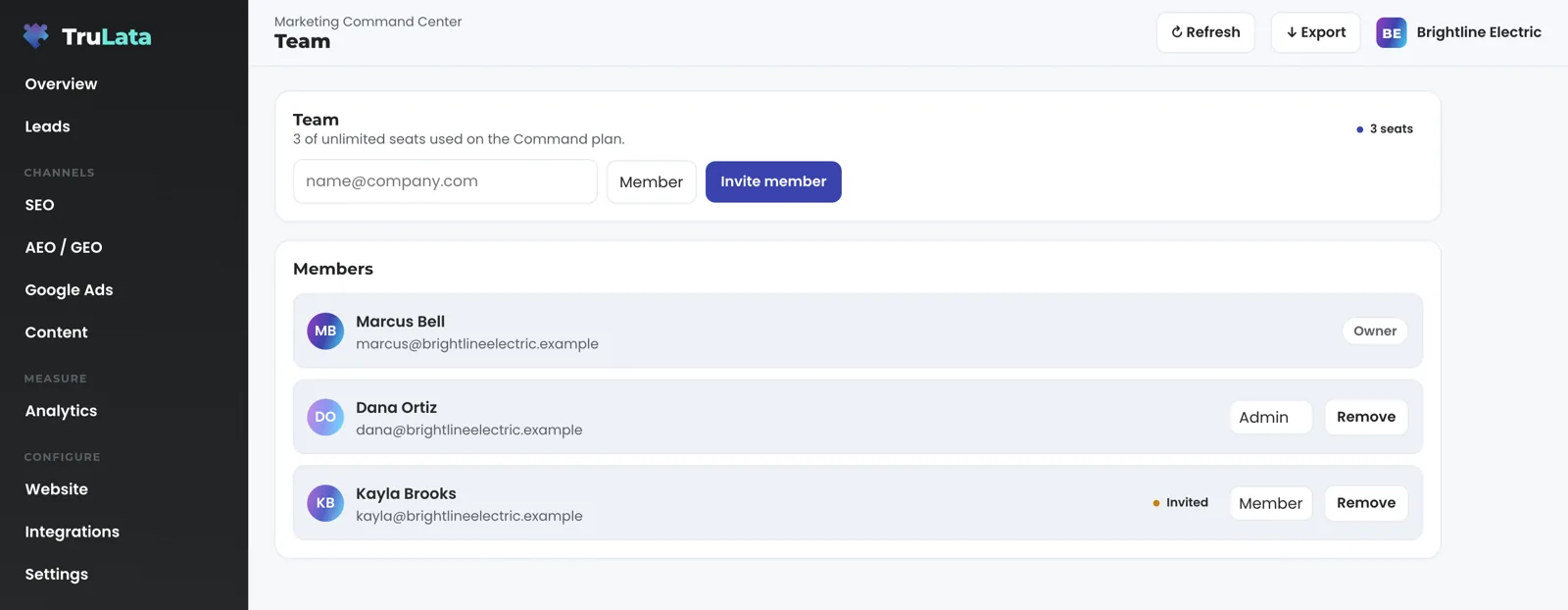
Yes. The product is built for your own people. Seats are three on Starter, three on Launch, ten on Growth and unlimited on Command. Invite your hire by email; they sign in with a single-use magic link and get the views your tier carries. The screen becomes their record: what each workstream is running, what the campaigns spent, which leads landed and the outcome set on each. Requests they make from inside it, a website change, a content topic, a keyword target, land with the team and are logged. The record no longer lives only in one person's head.
Your hire's hours move to the work that needed a person. Assembling a report by hand, checking the Ads account for changes, counting leads across three tools: the system takes those hours back. If the person moves on, the record stays on the screen, because the system assembled it, not their notes.
What does it cost next to a salary?
Set your own salary figure against our published prices. A salary figure for a hire is yours to set; we would have to invent one, and you already know what a person costs in your market with everything that sits on top of the salary. Starter is $400 a month, Launch $650, Growth $1,200, and Command is scoped per engagement. Every tier is one flat number, month to month, and an annual commitment takes 20 percent off the monthly.
Leave in any month. Revoke our manager access in your own Google consoles. Where the content engine runs, every piece has existed as a Google Doc from the day it was written, so your archive is already in your Drive the day you leave.
Starter is $400 a month, Launch $650, Growth $1,200, and Command is scoped per engagement.
One person next to the schedule.
| On mechanism | One hire | TruLata |
|---|---|---|
| Coverage | A working week, one set of eyes | Daily watches, a nightly bake, a pull whenever the page is opened, and weekly prospect sourcing on Command |
| Ads change history | Read when someone thinks to look | Read daily at 7:05am Eastern on every mapped account, plus the account user list |
| Lead count | Whatever the platform report says | Where forms feed the ledger, every submission written server-side and compared with Ads and GA4 by the daily lead watch |
| Answer engines | Asked by hand, if at all | ChatGPT, Gemini, Claude and Grok, each through its own API with web search on, the same bare question set across all four, at baseline and re-run as the program moves |
| Judgement | The hire's, all day | Budget and bid changes within the limits set for your engagement; prospect sends released by a person or on the engagement's schedule, every one logged; requests handled by the team |
| Relationships | The hire's | Our team runs the program on Command |
| When it ends | The knowledge leaves with the person | The record stays because the system assembled it; where the content engine runs, every piece is filed as a Google Doc as it is made; you revoke access; month to month |
You know what a person costs in your market, so the numbers on this page are ours: Starter is $400 a month, Launch $650, Growth $1,200, and Command is scoped per engagement.
Questions, answered.
Is TruLata a replacement for a marketing hire?
It is the hire's record and their schedule. It takes back the hours a hire spends assembling reports, checking accounts and counting leads, and leaves judgement and relationships with a person.
What can the system do that one person cannot?
Run on a schedule nobody has to remember: prospect sourcing weekly on Command, the ads change watch at 7:05am Eastern daily on every Ads account mapped to a client, the lead watch at 7:20am Eastern where forms feed the ledger, a fallback snapshot at 12:01am Central nightly, and a live pull whenever the page is opened. It also scores four answer engines through their own APIs on the same question set.
Can my own marketing person use it?
Yes. Seats are three on Starter, three on Launch, ten on Growth and unlimited on Command. Invite them by email; they sign in with a single-use magic link and get the views your tier carries.
Who does the judged work if I have no hire?
Our team. On Command, your full marketing team, always on, runs the program. A managed strategy retainer is an add-on on any tier, scoped with you. Managed Google Ads search, the AI visibility program and the content engine are carried by the tiers set out on the pricing page. The screen reports on all tiers, the ads change watch runs on every mapped Ads account, and the lead watch runs where your forms feed the ledger.
Why is there no salary comparison on this page?
We would have to invent it. You know what a hire costs in your market. Our numbers are published and identical on every page, and Command carries no number because it is scoped with you.
What happens to the work if the hire leaves, or if I leave?
The record stays. If the hire leaves, it is on the screen because the system assembled it, not their notes. If you leave, revoke our access in your own consoles; where the content engine runs, every piece already exists as a Google Doc, filed as it was made. Every tier is month to month.
See it running
before you decide.
The demo is the real product on a fictional company, with your name and email in front of it. Pricing is three published tiers.
Open the live demo See pricing
New here? See what TruLata is. Prefer to write? Send us the one thing you want to know.
Start here: AI marketing platform · AI marketing software · all-in-one marketing platform · marketing automation software · marketing software for small business.
- Refreshed when you open itLive data on page load, never a monthly PDF
- Counted from your own formsLeads recorded server-side, compared daily with Ads and GA4
- Seen in AI answersHow often ChatGPT, Gemini, Claude and Grok name you, measured
- Every send loggedProspect emails leave from a review-first queue, and every send is logged.