

Know what your email did this morning, without asking anyone for a report.
Open the email view and read your email platform's own numbers: sends, unique opens, unique clicks and unsubscribes from your recent campaigns, and the lifecycle flows running for your business. Every number on it is read from your platform's API, and a change to a flow reaches your team as a ticket from the screen.

What do I see when I open the email view?
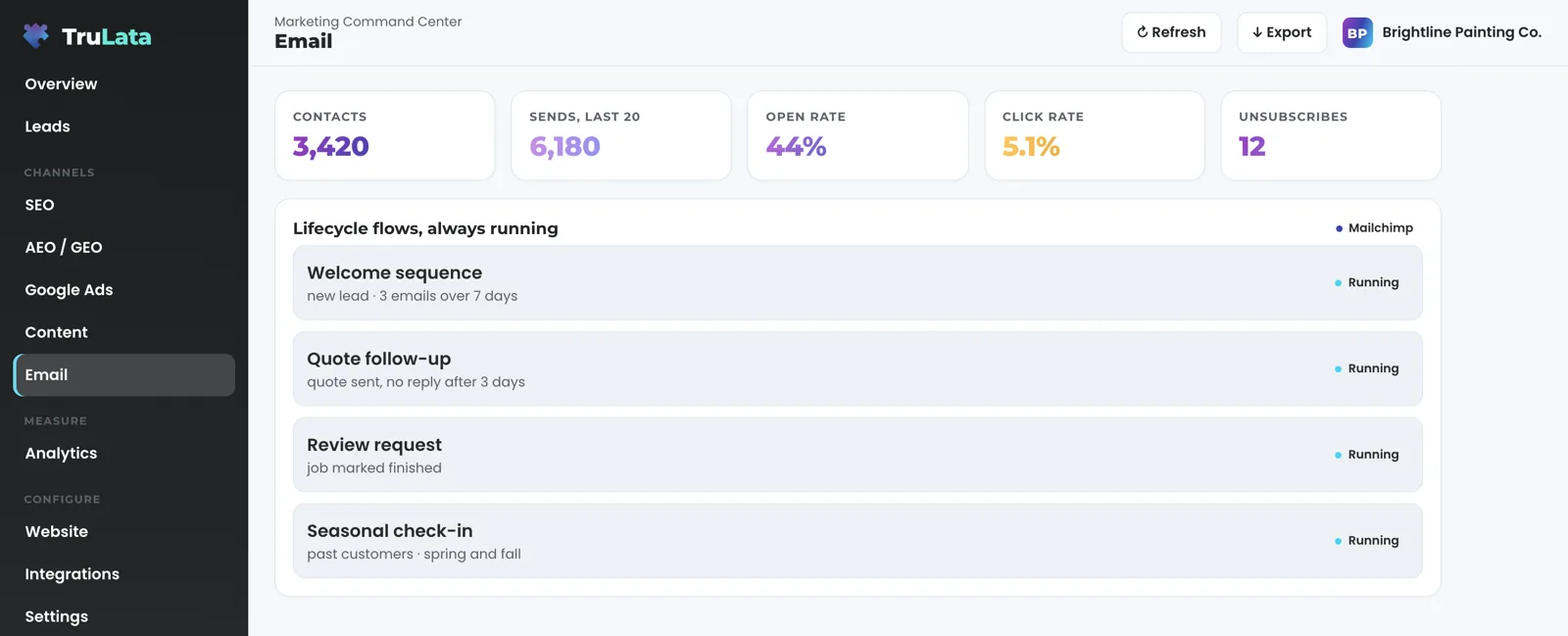
A stat row across the top, then a card of your lifecycle flows. Find the view in the sidebar under Channels, beside SEO, Google Ads, Content and Outbound. The stat row carries account totals from your email platform, such as sends across the recent campaigns read and the open and click rate across those sends. Click a tile and it opens to its current value, the window it covers and where it came from. Under the stat row, the flows card lists each flow by name, with a line of detail and a Running badge. Click a flow and it opens on its own.
Read the header before the numbers. It carries the time stamp of the data on the screen. Hover the stamp and it says one of two things: "Pulled live when you opened this page. Use Refresh for a new pull." or "Live refresh unreachable, showing the last saved snapshot." So you can always check which one you are reading. Two buttons sit in the top bar. Refresh pulls fresh data from your connected accounts now. Export downloads the view as trulata-email.csv with a Flow column and a Performance column, one line per flow, so the card goes into a spreadsheet without retyping.
Check all of this in the demo before you buy. demo.trulata.com asks for your name and email, runs the same engine code every client runs, and shows a fictional company with illustrative numbers. Open the email view there. Click a stat tile. Press Export and open the file. Then open the Support view and read the ticket table, because that is where a request to change a flow lands.
What does the flows card show?
Every sequence that sends itself. A lifecycle flow fires when something happens: a new lead gets a welcome, a quote that went quiet gets a follow-up, a finished job gets a review request. The card is titled "Lifecycle flows, always running". Each row names the flow and carries a line of detail. A short note under the card says how the whole thing runs.
Your flows are built with you later in setup, alongside your content cadence, ads reports and goals. They send from your own email platform to your own list.
Three parts of it run whether anyone is at a desk. Your flows send on their triggers from your own platform. The dashboard pulls your email statistics when someone opens it. At 12:01am Central a fallback snapshot is baked for every client, so the page always has last night's numbers to fall back on.
Changing a flow stays with a person. Send the request from any tab of the dashboard, or email [email protected]. Either way it reaches your team and lands in the Support view with a ticket number, the date it opened, whether it came from the dashboard or by email, and its status. Your team's replies show under the ticket, and the change is made in your platform by your team, so every pause, edit or new flow has a name and a ticket on it.
A flow fires when something happens
- A new lead
- A quote that went quiet
- A finished job
- A welcome
- A follow-up
- A review request
Are these this morning's numbers?
Yes. Email statistics are read from your email platform's API, and they are among the sources that move on every load, with your CRM, Stripe, your booking platform and website leads. Here is what happens when you open the page. It loads last night's snapshot first, so there is always a page to read while the live pull runs. It fetches the cached payload at once. If that payload is older than five minutes, a pull runs in the background and the numbers update.
Take a campaign you send at 9am. Open the dashboard at noon and it is in the read, newest first: how many contacts it went to, unique opens, unique clicks and unsubscribes. The read covers your most recent campaigns, up to 20, in send-date order. Open rate is unique opens divided by sends. Click rate is unique clicks divided by sends. Both are computed from those counts on every load. A contact who opens three times counts once.
Press Refresh at four and the pull takes between 2 seconds and a little over 3 minutes. The page reloads when the time stamp moves and puts you back on the email view where you were, whatever the pull returned. It will not reload over an open window or while you are typing. The header stamp keeps telling you how old the numbers are until you are done.
One limit, stated plainly. Every night at 12:01am Central a fallback snapshot is baked for every client. A failed pull or a failed syntax check leaves the previous page up, so the page you open always has last night's numbers at the least. Other sources on the dashboard have lower ceilings set by their owners: Google Ads and GA4 run hours behind during the day, and Search Console runs 2 to 3 days behind. Email statistics are live.
A campaign sent at 9am
- SentFrom your own platform
- In the readSends, unique opens, unique clicks, unsubscribes
- Refresh2 seconds to a little over 3 minutes, then a reload
- Fallback snapshotSo the page always has last night's numbers
A contact who opens three times counts once.
Which platform does it read, and do I have to move my list?
Whichever platform you send from: ActiveCampaign, Mailchimp, Klaviyo, HubSpot or any other platform with an API. No, your list stays where it is. The connection is an API key issued from your own account (in ActiveCampaign, under Settings, then Developer, with your account URL beside it). Our team makes the connection from the inside during setup, with access you grant, so your side of it is issuing the key. We never ask for your account password.
The key is tested against your account before it is stored. The test answers with the number of contacts on the account, so a wrong key is rejected at setup, not discovered later as an empty tile. The key is then encrypted at rest. A last-four hint of the key is kept in the clear, so we can confirm which key is on file without reading it. Your account URL is stored beside it as plain text; it is not a secret. The plaintext is decrypted server-side for the pull and is never returned to a browser. Ask, and the key is deleted from our store.
A platform we have not connected before is connected the same way during setup, through its API; the Integrations view of a live dashboard also has a Request an integration button, and the ask reaches your team as a ticket. Your customers' card data is never read on any account. Your inbox and your calendar sit outside the product today; the view reads what your email platform and your forms know.
- Issue a keyFrom your own account; in ActiveCampaign, Settings, then Developer
- Tested firstIt must answer with your contact count before it is stored
- Encrypted at restA last-four hint kept in the clear
- Server-side onlyDecrypted for the pull, never returned to a browser

Your list stays where it is.
Can a click on the screen email my customers?
Your customers hear from you through your own flows, on their triggers. A click on the screen reads a number or sends a request to your team: ask a question where that view is offered, set a lead outcome, request a website change, or request a content, keyword, category or targeting change. Each request is logged. Changes to your email platform, your ads account, your CRM, your site and your Business Profile are made by your team and the engine through each platform's API.
Your flows do send, from your own platform, on their triggers, under rules built with you. Prospecting to new businesses is a different engine on its own page: prospect emails leave from a review-first queue; a person releases them, or the queue releases on the schedule set for the engagement, and every send is logged with the draft, the mailbox and the time. Replies are classified and shown, and not-interested or bounced addresses are suppressed from further sends. Named accounts you specifically want are always reviewed by a person before anything leaves.
Your inbox sits outside the product today. The view knows what your email platform and your forms know, and it says so.
A click on the screen
- Reads a number
- Sends a request to your team, logged
- Sets a lead outcome
What emails your customers
- Your own flows, on their triggers
- From your own platform
- Under rules built with you
How does email connect to my leads?
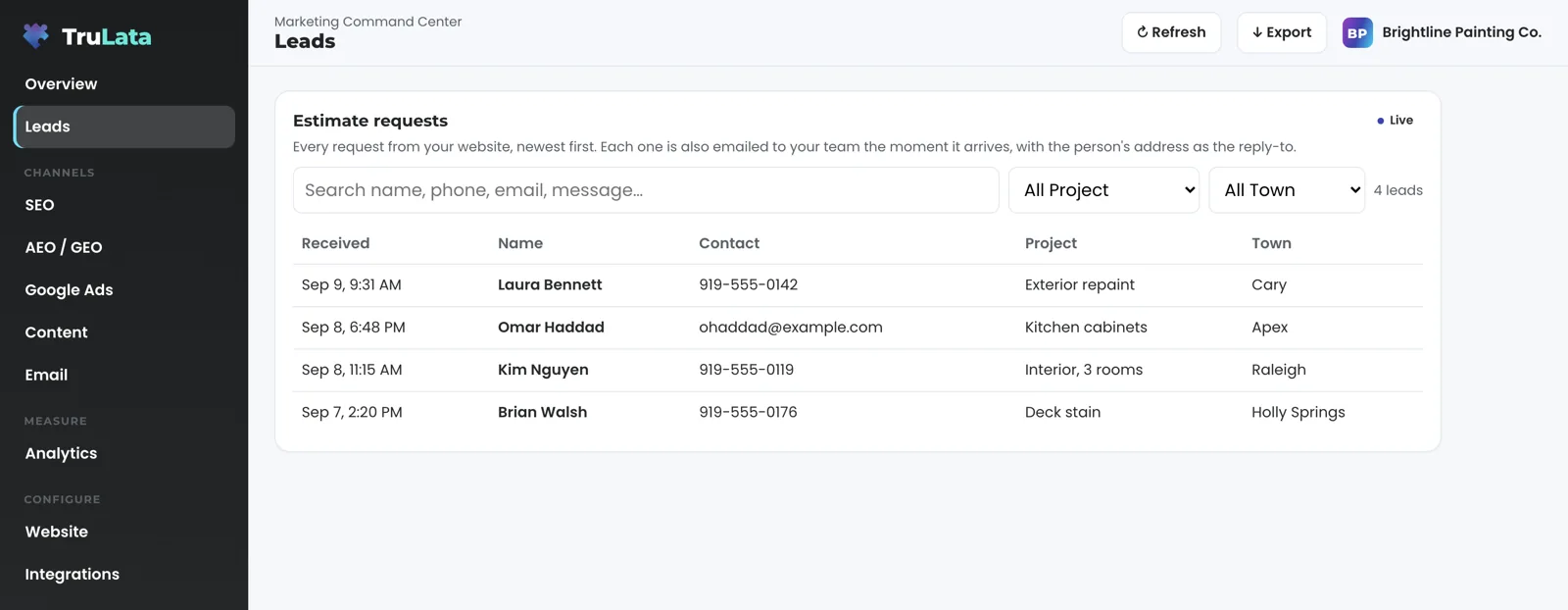
At the moment a lead arrives. When someone submits a form on your site, the form handler appends the lead to your lead sheet server-side and emails your team, so the first email a lead triggers is the one that tells you they exist. That email carries the lead's own address as its Reply-To, so your first reply goes straight to the person. The Leads view reads the sheet newest first: received time, name, phone, email, what they asked for, their message and the page they were on.
From there your CRM and your flows take over. A welcome or follow-up flow sends from your email platform on the rules built in setup, and the email view lists it by name. Leads are counted from your own forms, and the ad platform's report sits one tab over for comparison. Set a lead outcome on the Leads view and it writes to the lead record, and the change is logged.
What the email view reads.
| What | Where it comes from | How fresh |
|---|---|---|
| Campaign statistics | Your email platform's API: sends, unique opens, unique clicks, unsubscribes; the most recent campaigns, up to 20, newest first | Live |
| Open rate, click rate | Computed from sends and unique opens or clicks on every load | Live |
| Account totals | Sends, open rate and click rate across the recent campaigns read | Live |
| Lifecycle flows | The flows built with you in setup, listed by name with a status and a note on each | Per account |
| Platform | ActiveCampaign, Mailchimp, Klaviyo, HubSpot or any other platform with an API, connected during setup | Per account |
| Your customers' card data | Never read | Every account |
| Your inbox and calendar | Outside the product today | Per account |
| A change to a flow | A request from the screen or by email, to your team as a numbered ticket | Logged |
The email view reads your platform through its API. Your list stays where it is, your flows send from your own platform, and a change to a flow reaches your team as a logged ticket.
Questions, answered.
Which email platforms are supported?
Whichever you send from: ActiveCampaign, Mailchimp, Klaviyo, HubSpot or any other platform with an API. Your list stays where it is; the connection is an API key from your own account, made by our team during setup, and a platform we have not connected before is connected the same way.
Are open and click rates live?
Yes. The page reads your platform's API when it opens, runs a pull in the background when the cached payload is older than five minutes, and Refresh pulls on demand in 2 seconds to a little over 3 minutes.
Does TruLata send email to my customers?
Your flows do, from your own platform, under rules built with you. A click on the screen reads a number or sends a request to your team, so every send to a customer has a flow and a rule behind it.
Do you read my inbox?
The view reads your email platform's API and your forms. Your inbox and your calendar sit outside the product today.
Can I pause a flow from the screen?
Request it from any tab and your team pauses it in your platform; the request lands in the Support view with a ticket number, and your team's reply shows under it.
What is a lifecycle flow?
A sequence that sends itself when something happens: a welcome after a new lead, a follow-up after a quiet quote, a review request after a finished job.
How long does Refresh take?
Between 2 seconds and a little over 3 minutes, depending on the account. The page reloads when the time stamp moves and returns you to the view you were on, whatever the pull returned.
See it running
before you decide.
The demo is the real product on a fictional company, with your name and email in front of it. Pricing is three published tiers.
Open the live demo See pricing
New here? See what TruLata is. Prefer to write? Send us the one thing you want to know.
Start here: AI marketing platform · AI marketing software · all-in-one marketing platform · marketing automation software · marketing software for small business.
- Refreshed when you open itLive data on page load, never a monthly PDF
- Counted from your own formsLeads recorded server-side, compared daily with Ads and GA4
- Seen in AI answersHow often ChatGPT, Gemini, Claude and Grok name you, measured
- Every send loggedProspect emails leave from a review-first queue, and every send is logged.