

Know how your marketing is going without asking anyone.
A marketing command center reads your accounts itself and tells you how old the data is. You open one screen instead of waiting on a report.

What is a marketing command center?
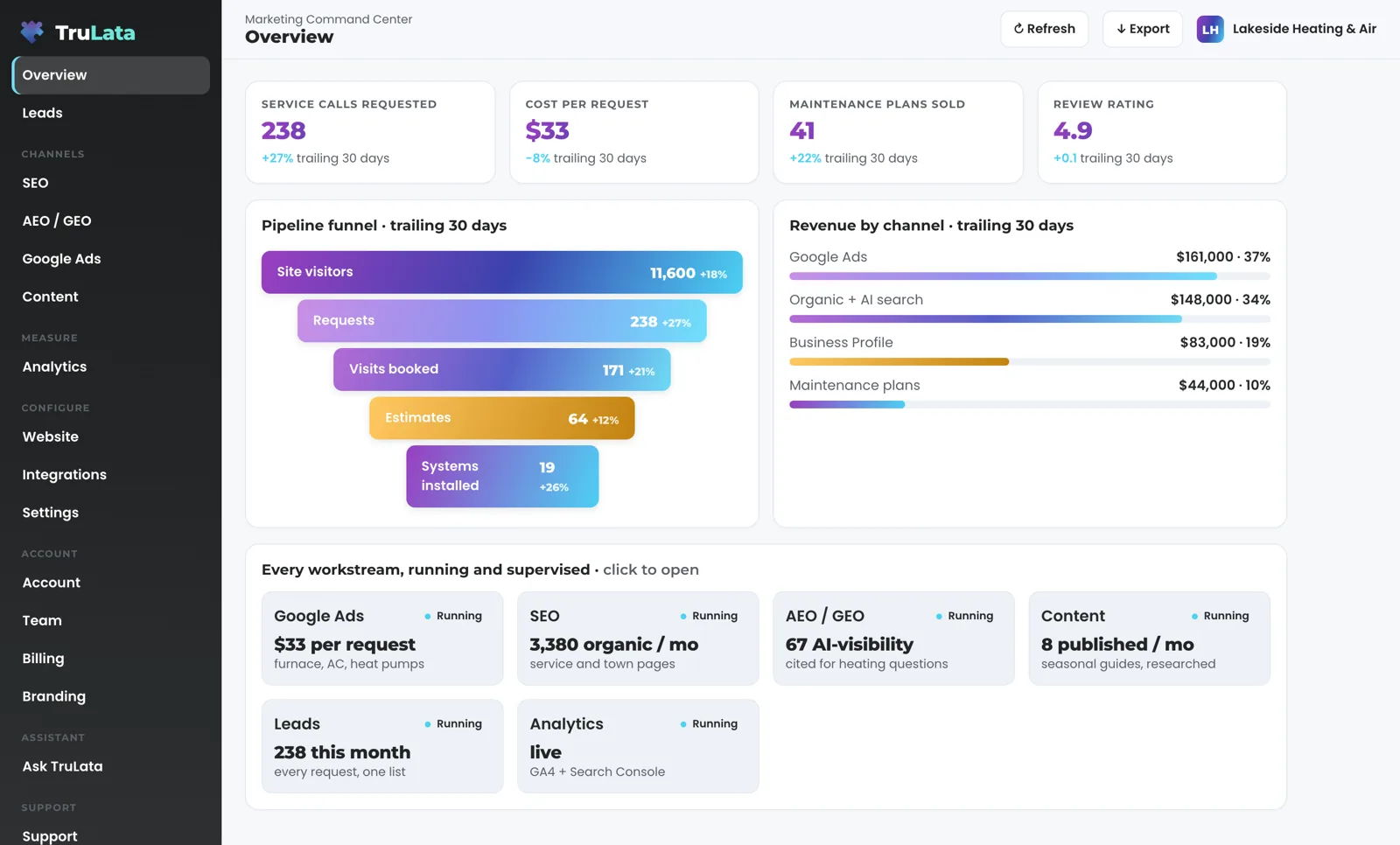
A marketing command center is one screen that reads a business's marketing, lead and revenue sources directly and shows each connected workstream side by side with the age of its data stated, so the owner can see how marketing is going without asking anyone.
It goes beyond a dashboard and a report in three ways. It reads your source accounts itself, through access you grant. It carries the work: the outbound queue, each content piece, the ads change watch and the lead watch run inside it. And it lets you act: set a lead outcome or send a logged request to a person, from the screen.
What do I get that my dashboard does not give me?
Your dashboard shows what it was given. Someone exported a file or set up a connector once, and the charts show that feed. Its freshness is whatever the feed happens to be, and the screen rarely says.
You get three parts a dashboard leaves out. The connections run to the accounts themselves, through access you grant, so the screen shows what Google, your CRM and your payment processor hold, each within its own freshness ceiling. The work runs inside it: the outbound queue and each content piece sit on the screen with their status, and the ads change watch and the lead watch raise what they find to the team. And you act from it. Set a lead outcome, or request a website, content, keyword, category or targeting change. Each request reaches your team as a logged ticket, and the engine's writes to your ad accounts and your site go through their APIs and land in each account's own change history. The security page lists every write path.
A dashboard
- Shows what it was given
- A feed someone set up once
- Rarely says how fresh it is
A command center
- Reads your accounts itself
- The work runs inside it
- You act from it: outcomes and logged requests
Can I stop waiting for a report?
Yes. A report is a snapshot chosen by whoever sent it, covering a period that has closed. Its numbers are as old as the pull behind it. What it leaves out was a decision you were not part of.
A command center refreshes because you opened it. TruLata's loads last night's snapshot first, fetches the live payload from a cache at once, and runs a fresh pull behind the page when that snapshot is older than five minutes. Open a number and a detail card shows the figures behind it. A view appears as its source is connected, and every figure on it is read from that source. The screen is the report, and each view exports to CSV. Why the page refreshes when you open it has the timings.
Refresh, in order
- Last night's snapshoton screen at once
- The live payloadfetched from cache
- A fresh pullruns behind the page
- A full pullthe page reloads when the stamp moves
The screen is the report.
Which of my accounts does it read, and how fresh is each?
It reads the accounts you already run on, through access you grant and can revoke. Google Analytics 4: sessions, sources, pages and key events, hours behind intraday. Search Console: queries, impressions, clicks, average position and top pages, two to three days behind; those positions are Search Console averages, not a rank tracker. Google Ads: spend, conversions and cost per conversion, hours behind intraday, plus the account's change history and user list, which the ads change watch reads at 7:05am Eastern each day. Google Business Profile: reviews, rating and listing performance. Your CRM: pipeline stages and lead sources, live; read from whichever CRM you run. Stripe: payments, subscriptions and recent charges, read only. Where they apply, your booking platform, your email platform, Meta and your website platform, all listed in the integrations index, and any other system your business runs on with an API is connected during setup.
Your website forms are the ground truth for leads. Each submission lands in a lead sheet server-side as it arrives, and the Leads view reads that sheet newest first. Your inbox, your calendar and customer card data stay yours. Phone calls count through your CRM today, and a call-tracking platform is connected during setup where your business runs on one.
Sources and their lag
- GA4
- Search Console
- Google Ads
- Business Profile
- Your CRM
- Stripe
- Live: your CRM, Stripe, forms, email stats
- Hours behind: Google Ads, GA4
- 2 to 3 days: Search Console

Your website forms are the ground truth for leads.
What do I get with TruLata?
You get one TruLata dashboard at your own trulata.com subdomain, behind our sign-in gate. It is served from Cloudflare's edge by one app that serves every dashboard. A small function at the edge holds the shared secret and forwards to the managed cloud service that serves the live payload, so the secret stays at the edge and your browser talks to your own site. If that service is unreachable, you see last night's numbers, so the page always opens with something to read. A view appears as its source is connected: Jobs arrives when your CRM or booking platform is reading. The Overview page lists the rest.
The engines run inside it, by tier, on a schedule whether anyone is at a desk. Where your plan includes the outbound engine, it sources prospects weekly to your target profile; prospect emails leave from a review-first queue; a person releases them, or the queue releases on the schedule set for the engagement, and every send is logged. Where your plan includes the content engine, it takes each piece from queued to posted and files it as a Google Doc in your Drive. The ads change watch reads your account's change history at 7:05am Eastern each day and raises material changes, including Google's own automation, while setting aside our routine API writes. The lead watch runs at 7:20am Eastern where forms feed the sheet, compares the form ledger with what Ads and GA4 counted over the last seven days, and raises it when leads landed but Ads or GA4 counted none. Answer-engine presence, on all tiers, is scored across ChatGPT, Gemini, Claude and Grok at baseline and re-run as the program moves.
Sign in with a single-use magic link. Your sign-in link authenticates, our seat list authorises, and a removed seat stops working within thirty seconds. Every Google connection is a grant you can revoke yourself; we never ask for a client's account password. The TruLata dashboard is on all tiers (pricing).
- Your own subdomainOn trulata.com, behind our sign-in gate
- A single-use magic linkYour sign-in link authenticates, our seat list authorises
- A removed seatStops working within thirty seconds
- Every Google connectionA manager invitation you can revoke yourself
Is this for my business?
It is when you sell a service. A territory is typical, and a multi-location or national business fits the same way. Whether the owner fits the marketing in or a marketer runs it, the command center is where that job gets done: the search, ads, content, outbound and email work runs on a schedule, on the tiers that carry it, whether or not you had time this week; every lead is counted from your own site; one screen shows what happened and what it cost. The owner as the marketing department and how this compares with an agency retainer go further.

Dashboard, report, command center.
| The question | A dashboard or a report | A marketing command center |
|---|---|---|
| Where the numbers come from | An export, or a connector someone set up once | Your source accounts, through access you grant and can revoke |
| How fresh | As of the last export, or the day it was sent | Refreshed when you open it; the header stamp says how old the data is |
| A source that is missing | Absent from the screen, or filled in | Shown as it is connected, every figure read from the source |
| The work itself | Happens somewhere else | Outbound and content run inside it; the ads watch and the lead watch raise what they find to the team |
| Acting on it | You reply to whoever sent it | Set a lead outcome or request a change from the screen, logged, to a person |
| Who can see it | Whoever was sent the file | Your seat list, magic-link sign-in, revocation within 30 seconds |
Search Console runs two to three days behind, so the header stamp says how old the data is instead of pretending it is live.
Questions, answered.
Is a marketing command center the same as a marketing dashboard?
They differ in what they read and what they let you do. A dashboard displays numbers it is given. A command center reads your source accounts through access you granted, runs the work inside it, states how old the data is, and lets you act from the screen through logged requests to a person.
Does it replace the report I get each month?
Yes. The screen refreshes when you open it, each view exports to CSV, and the header stamp says how old the data is. The screen is the report.
What does it read?
Google Analytics 4, Search Console, Google Ads, Google Business Profile, your CRM and Stripe, plus your booking platform, your email platform, Meta and your website platform where they apply, plus every website form submission, recorded server-side as it lands. Any other system with an API is connected during setup. Your inbox, your calendar and card data stay yours, and phone calls count through your CRM today.
Can I change anything from the screen?
Yes. Set a lead outcome, which writes to the lead record, or request a website, content, keyword, category or targeting change, which reaches your team as a logged ticket. The engine's writes to your ad accounts and your site go through their APIs and land in each account's own change history.
How fresh are the numbers?
Live for your CRM, Stripe, your booking platform, website leads and email statistics. Google Ads and GA4 intraday lag hours. Search Console runs two to three days behind. The page refreshes when you open it and falls back to last night's snapshot if the live service is unreachable.
What does one cost?
The TruLata dashboard is on all tiers. Starter is $400 a month, Launch $650, Growth $1,200, and Command is scoped per engagement. Month to month, nothing metered.
See it running
before you decide.
The demo is the real product on a fictional company, with your name and email in front of it. Pricing is three published tiers.
Open the live demo See pricing
New here? See what TruLata is. Prefer to write? Send us the one thing you want to know.
Start here: AI marketing platform · AI marketing software · all-in-one marketing platform · marketing automation software · marketing software for small business.
- Refreshed when you open itLive data on page load, never a monthly PDF
- Counted from your own formsLeads recorded server-side, compared daily with Ads and GA4
- Seen in AI answersHow often ChatGPT, Gemini, Claude and Grok name you, measured
- Every send loggedProspect emails leave from a review-first queue, and every send is logged.