

Know what each marketing term means, and hold any vendor to it.
Seven terms you will hear from anyone selling marketing, defined in one sentence each. Every page then names what TruLata reads to measure the term, so you can check the next vendor's claim against it, including ours.

What does each term mean, in one sentence?
Open a term to read the full definition, what TruLata reads to measure it, and where the term's meaning stops.
What does a vendor mean when they say these words?
Each term here is a real thing with a real measurement behind it. Each is also a word attached to dashboard tiles to make them sound rigorous. Read the one-sentence definition, then the line that names what is read to measure it, and you can hold any vendor to the word, including us.
Search for the two AI terms today and the answer comes from an encyclopedia or a large marketing publisher. That is who held the results when we measured them, and outranking an encyclopedia for a dictionary entry is not the aim. These pages answer a narrower question: what the term means for a local service business with a dashboard, with the measurement beside it, on the site that does the measuring.
A word on a vendor's tile
- Sounds rigorous
- Nothing says what was read to measure it
A word on these pages
- A one-sentence definition
- The line naming what is read to measure it
- The question to ask the next vendor
What gets your business quoted in an AI answer?
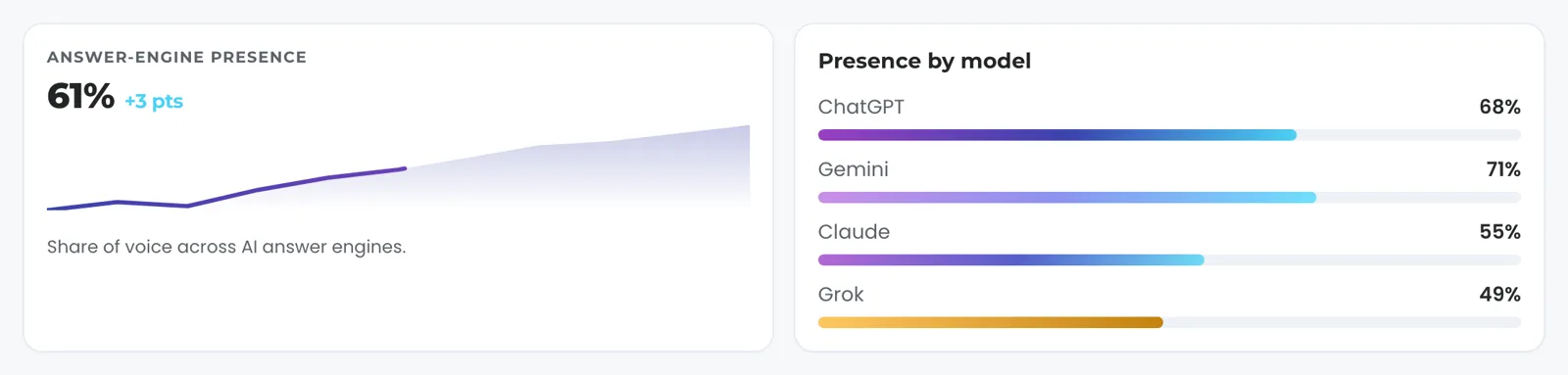
A plain sentence gets quoted. Our answer-engine view asks ChatGPT, Gemini, Claude and Grok a buyer's question bare, the way a person types it, with web search on, because that is what a person sees in the app. The engines build their answers from pages that state a fact plainly: what the business is, where it works, what a word means. A definition on its own line is easier to lift than one buried under three paragraphs of pitch.
The exact words decide the result. On one measured business, all four engines named it for one phrasing of a question in its own town, two of four for a neighbouring phrasing, and none for the next town over. So every definition page here leads with the sentence, keeps the term in the words a buyer types, and follows it with the measurement instead of a claim. The same discipline runs the program on the AI search services page; these pages are its vocabulary.
What an engine can lift
- Asked bare, the way a person types it
- Web search on, for every engine
- Quote a plain sentence: what you are, where you work
- Pass over a definition buried in pitch
How do you know whether AI engines name your business?
Ask the engines and count the answers. Answer engine optimization and generative engine optimization are two names for work judged by the same instrument, so they share one view. A fixed set of questions, in the words your customers use, goes to ChatGPT, Gemini, Claude and Grok through each engine's own API. The view records whether each answer names your business. You get a score, a per-engine breakdown and the list of questions where you were cited and where you were not. Scoring runs at baseline and again as the program moves, and the date of the last run sits on the view.
Two rules keep the score honest. A blank answer is a measurement error, never a miss, so it leaves the denominator. Google's AI Overviews are measured on the search visibility view, because they are a search result and behave like one. All of it sits on the marketing command center: one dashboard per client, refreshed when you open it, with a header stamp that says how old the data is.
How do you know which channel a lead came from?
Your own site writes the record. When someone submits a form, the form handler appends a row to a lead sheet server-side and emails your team. Where your site's forms capture it, that row carries the traffic source, first page visited and referrer as they stood at submission. That is lead source tracking as these pages use the term, and it is the ground of marketing attribution here: a lead belongs to the channel recorded when it landed, not to the channel a platform claims later.
First-party data is the plain name for those records: the lead sheet, the CRM, the payment history, the content filed as Google Docs in your Drive. They live in your accounts. We read them through access you grant during setup and never ask for your account passwords. GA4 key events and Google Ads conversions sit on top as the measurement layer, what a tag counted. On the instance whose forms feed the sheet, a daily check at 7:20am ET compares the ledger against both and alerts our team when leads land in the sheet while a tag counted none. The day a tag breaks is the day the platform reports zero while real leads keep landing.
One lead, three counts
- A row in the lead sheetsource, first page and referrer, written server-side
- GA4 key eventswhat the tag counted, published hours behind
- Ads conversionswhat Google counted, published hours behind
- Comparedan alert when leads land and a tag counted none

Ranking is not earning.
What do these pages not claim?
These pages name the positions for what they are: Search Console's average positions, two to three days behind, labelled that way on the search view. A phone lead counts where your CRM records it, and a call-tracking platform with an API is connected during setup where you run one. Your inbox and calendar are connected only where you ask for it during setup. Answer-engine scoring runs as the program moves, and the date of the last run sits behind the score. Where a term page names a limit, the limit is real today and the page says how it grows.
Ranking is not earning. What these pages count is the lead your own forms recorded and what it became, and that is the number to read a position against. Judge these pages by one test: after reading one, you know what to ask a vendor next.

Seven terms, what is read, how fresh it is.
| Term | What TruLata reads | How fresh |
|---|---|---|
| Marketing command center | The accounts connected during setup, one dashboard per client, refreshed when you open it | One pull stamp in the header; each source keeps its own lag |
| Answer engine optimization | ChatGPT, Gemini, Claude and Grok through their APIs, a fixed question set | As of the last scoring run, dated |
| Generative engine optimization | The same answer-engine view; AI Overviews on the search view | Last run, dated; AI Overviews on the search view |
| Marketing attribution | The lead sheet source recorded at submission | Live, the moment a form is submitted |
| First-party data | Your lead sheet, CRM, payments and Drive, through access you grant | Live for your CRM, Stripe, your booking platform and email stats |
| Lead source tracking | Traffic source, first page visited and referrer, written to the lead sheet where your site's forms capture them | Live, the moment a form is submitted |
| GA4 key events vs conversions | GA4 key events and Google Ads conversions, compared with the ledger daily where a lead watch runs | Hours behind, set by Google |
Every term page names what is read, where it comes from and how fresh it is.
Questions, answered.
What is a marketing command center?
One screen that reads your marketing, lead and revenue accounts directly and shows them together. Each number opens to its detail and the page says how old the data is. Ours is one dashboard per client, refreshed when you open it.
Is answer engine optimization the same as generative engine optimization?
Yes, in practice. They are two names for the same work seen from two angles: being named by an engine that answers, and being quoted by an engine that writes its answer. TruLata measures both with one view across ChatGPT, Gemini, Claude and Grok.
What is the difference between a GA4 key event and a conversion?
A key event is an action your GA4 property is set to count. A conversion is what Google Ads counts against a click. Both are measurements. Your form submissions, written to the lead sheet server-side, are what happened, and on the instance whose forms feed the sheet a daily check compares the three.
How is a lead's source recorded?
At submission, by your own site. Where its forms capture it, the form handler writes the traffic source, first page visited and referrer to the row in the lead sheet.
Does TruLata track rankings?
It shows Search Console's average position for the queries Search Console reports, two to three days behind, and labels it that way.
How often is answer-engine visibility scored?
At baseline, then again as the program moves, with the date of the last run behind the score.
See it running
before you decide.
The demo is the real product on a fictional company, with your name and email in front of it. Pricing is three published tiers.
Open the live demo See pricing
New here? See what TruLata is. Prefer to write? Send us the one thing you want to know.
Start here: AI marketing platform · AI marketing software · all-in-one marketing platform · marketing automation software · marketing software for small business.
- Refreshed when you open itLive data on page load, never a monthly PDF
- Counted from your own formsLeads recorded server-side, compared daily with Ads and GA4
- Seen in AI answersHow often ChatGPT, Gemini, Claude and Grok name you, measured
- Every send loggedProspect emails leave from a review-first queue, and every send is logged.