

Marketing attribution: know which channel sent the customer.
On a site we build with three-bucket capture, your site writes the source on the lead row the moment the form is submitted: Paid, AI Search or Organic, with the raw click ids, campaign tags and referrer kept beside the label. Check a credit you doubt against what the browser sent instead of taking it on trust.

What is marketing attribution?
Marketing attribution assigns credit for a lead or a sale to the channel that produced it. When a customer pays, it answers one question: which channel sent that person. For a local service business the channels are few and concrete: paid search, organic search, a referral from another site, a social profile, or direct, meaning the person typed your address or used a bookmark.
The word covers a family of methods. First-touch credits the channel that brought the person to your site the first time. Last-touch credits the channel that brought them back on the visit when they converted. Multi-touch splits the credit across every visit it can see. Each method is only as honest as the record underneath it.
One customer, three visits
- A paid clickfirst-touch credits this one
- An organic searchmulti-touch splits the credit across every visit it can see
- Typed your address, sent the formlast-touch credits this one
How do you know where a lead came from?
Most attribution rests on a cookie. An analytics or ad platform's script sets it when the visitor lands, and a second script fires when the form is sent. Block the cookie, let it expire, switch devices, or lose the second script, and the credit is lost or misfiled. The platform still reports a number as if nothing went wrong.
A site we build with three-bucket capture records the source at the moment the form is submitted. The site's own script notes the page that sent the visitor and any click ids or campaign tags on the link they clicked, and keeps them for the whole visit. When the form goes in, the form handler reads those signals, names the channel and writes it to the lead row in the same server-side append as the name, phone and message. The credit sits on the record your own site writes before any tag has a chance to fail.
Three labels cover every visit. A click carrying a Google, Meta or Bing click id, or a paid medium tag, is named Paid, with the network and the campaign or creative that earned it. A visit referred by an answer engine is named AI Search, with the engine. Everything else is Organic. Ordinary referrals and direct visits fold in there on purpose: they are earned rather than bought, and a visit whose referrer the browser stripped arrives as direct even when it began on a search page. The raw click ids, campaign tags and referrer are written in the next column, so you audit a label that looks wrong back to what the browser sent. The Leads view reads that sheet newest first, and each row carries its named channel.
Three labels cover every visit
- A Google, Meta or Bing click id, or a paid tag
- A visit referred by an answer engine
- Everything else, referrals and direct included
- Paid
- AI Search
- Organic
The credit sits on the record your own site writes before any tag has a chance to fail.
Can you see revenue by channel?
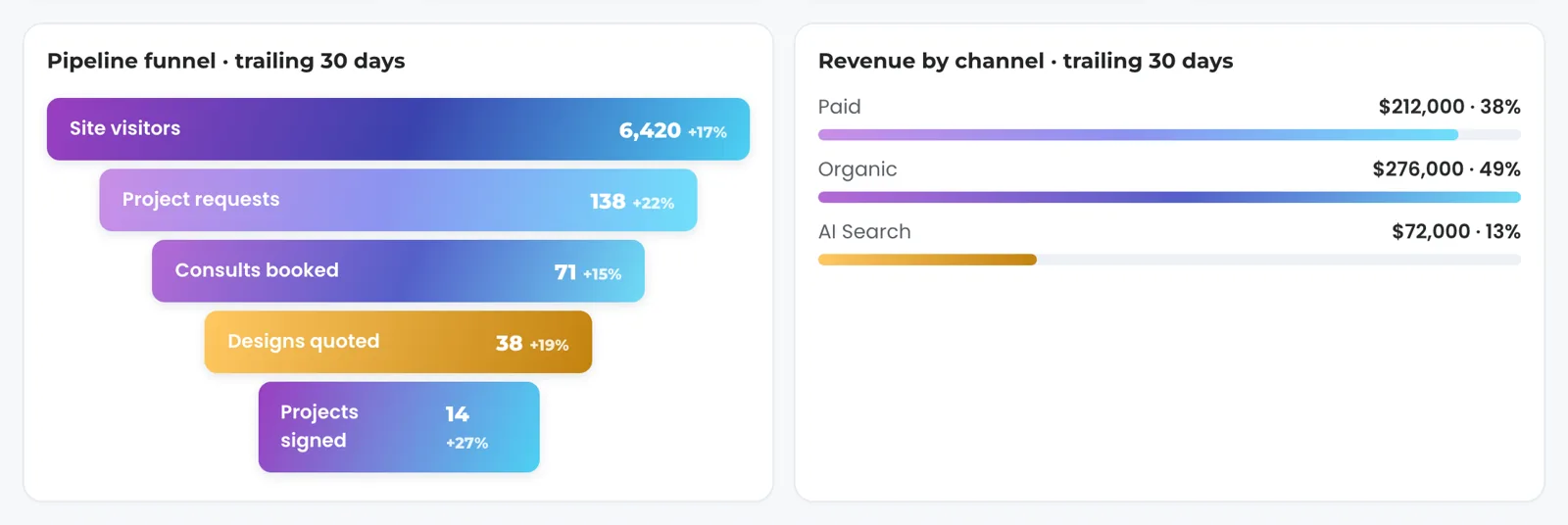
Revenue and lead source are read side by side today. A lead's source says which channel produced the inquiry. Revenue by channel needs one more thing: the source on the deal. The Revenue view shows the payment record from Stripe, live. Your CRM carries a source on each opportunity. Where our team configures a revenue split for your instance, it appears on the Overview and comes from what your payment records carry, so every figure traces to a payment, and the join from a payment to the lead that produced it is added as it is built. How the source lands on the lead row is where that source starts.
Any CRM with an API connects, and pipeline stages and sources are read from it.
Why do GA4, Google Ads and your lead count disagree?
Each one records a different event. Google Analytics 4 counts sessions by source and the key events its tag saw, hours behind. Google Ads counts the conversions its own tag reported, also hours behind. The lead ledger counts forms actually submitted, live. What GA4 counts and what Ads counts has a page of its own. On the instance whose forms feed the sheet today, a lead watch runs daily at 7:20am ET and compares the three. It raises five conditions: the tag no longer loads, leads landing with zero GA4 form events, paid leads landing with zero Ads conversions, a campaign that reliably spent going to zero, and traffic continuing with no leads at all.
The watch exists so the three counts are reconciled every day rather than at the end of the quarter. It reads your own record of what came in, then the conversions Google counted for the same period. A dead tag, a blind ad account or a stalled form is flagged the next morning, while the budget is still yours to move. Attribution built on tags alone can say the opposite of the truth for a whole quarter before anyone looks.
Three counts, three different events
- Lead ledgerForms actually submitted, live
- GA4 key eventsWhat its tag saw, hours behind
- Google Ads conversionsWhat its own tag reported, hours behind
- Lead watchReconciles the three daily at 7:20am ET, where forms feed the sheet

Each one records a different event.
Where does the record stop?
A phone call, until a system records it. A phone lead counts when your CRM records it, with the source your staff wrote down, and where you run a call-tracking platform with an API, it is connected during setup. A recommendation. A neighbor's word shows up as Organic, because the person typed your address and the visit carries no referrer. A journey across devices. Someone who clicks an ad on a phone at lunch and fills in the form from a laptop that evening looks like two visitors, and the second one carries no campaign tag.
After the lead, the outcome you set. Where the Leads view offers it, each lead carries an outcome you set from the screen: contacted, quoted, won or lost, and a lead with no outcome stays a counted lead. On a site built with three-bucket capture, the row keeps the raw click ids, campaign tags and referrer beside its label, so you check a credit you doubt instead of taking it on trust.

What does a wrong number cost you?
One customer. Where the owner carries marketing on the side, nobody else stands between a bad number and a bad decision. Cut a channel because a report said it produced nothing, and the phone simply rings less. Start from your own forms and your own CRM, know where the record stops, and you stop reading a report and start knowing what happened. Prove which dollar made the phone ring is the owner's version of this page.
Reading a report
- A channel cut because a report said it produced nothing
- The phone simply rings less
Knowing what happened
- Start from your own forms and your own CRM
- Know where the record stops
Attribution, signal by signal.
| Signal | Where it is recorded | What it can say |
|---|---|---|
| Lead source | The form handler on a site we build, on the lead row, at submission | Which channel sent the form, live |
| Submitted page and referrer | The same lead row | The page the form was sent from and the page that sent them |
| Campaign tags | The same lead row, when present on the link | Which campaign the click carried |
| Revenue | Stripe, on the Revenue view | Paid revenue, live, read beside the lead source |
| GA4 traffic by source | Google Analytics 4, hours behind | Sessions by source, not customers |
| Ads conversions | Google Ads, hours behind | What Google's tag counted |
| Phone leads | Your CRM, as your staff record them | The source your staff entered |
On a site we build with three-bucket capture, every lead is labeled Paid, AI Search or Organic, with the raw click ids, campaign tags and referrer written beside the label, so you check a credit you doubt against what the browser sent.
Questions, answered.
What is marketing attribution in one sentence?
Assigning credit for a lead or a sale to the marketing channel that produced it, so you know which channel sent the customer.
Do you use cookies for attribution?
The lead row is written without one. On a site we build with three-bucket capture, the site's own script notes the referrer and any click ids or campaign tags during the visit, and the form handler writes the named channel to the lead row at submission. GA4 and Google Ads still use their own tags, and their counts appear for comparison.
Is first-touch or last-touch better?
Neither, on its own. The lead row carries the page the form was sent from, the referrer and the campaign tags of the visit in which the form was submitted. On the instance that runs it, a daily lead watch compares lead counts against what GA4 and Ads counted.
How is revenue attributed to a channel?
Today, revenue and lead source are read side by side: payments live from Stripe on the Revenue view, and the opportunity source from your CRM. Any revenue split you see is by product line from the payment record, so every figure traces to a payment rather than a modelled channel, and the join from payment to lead source is added as it is built.
Can it attribute phone calls?
Through your CRM today: a phone lead counts when your CRM records it, with the source your staff entered. Where you run a call-tracking platform with an API, it is connected during setup.
What happens when the visit carries no source?
The lead is labeled Organic, and the raw click ids, campaign tags and referrer are written beside the label. Referrals and direct visits fold into Organic on purpose: a separate direct bucket invents a distinction the record has no signal for. On a site that keeps a Direct label, a visit with no signals captured reads Unknown (not captured), and the lead is still counted.
See it running
before you decide.
The demo is the real product on a fictional company, with your name and email in front of it. Pricing is three published tiers.
Open the live demo See pricing
New here? See what TruLata is. Prefer to write? Send us the one thing you want to know.
Start here: AI marketing platform · AI marketing software · all-in-one marketing platform · marketing automation software · marketing software for small business.
- Refreshed when you open itLive data on page load, never a monthly PDF
- Counted from your own formsLeads recorded server-side, compared daily with Ads and GA4
- Seen in AI answersHow often ChatGPT, Gemini, Claude and Grok name you, measured
- Every send loggedProspect emails leave from a review-first queue, and every send is logged.