

Be the business the AI names.
Your next customer asks ChatGPT, Gemini, Claude or Grok who to call and gets a handful of names, not a page of links. See whether yours is one of them, question by question and town by town, and which questions still need work.

Do my buyers really ask an AI who to call?
The ones who do get names, not links. A search engine returns a page of links and the buyer picks. ChatGPT, Gemini, Claude and Grok write one answer, name a handful of businesses, and the buyer calls one of them. With web search on, the apps read the live web to write that answer. For a local trade that means your Business Profile, the directories and the review sites. A business with reviews and presence in its towns is exactly the kind an engine can find, or miss.
Your buyer names their town when they ask, so the question is about your trade in your towns, not the internet in general. This page is for the business TruLata is built for: one that sells a service across a territory, whoever runs its marketing. The territory makes the question concrete. The useful answer covers your buyer's address, and so does the measurement.
What the engine reads to answer
- Your Business Profile
- Directories
- Review sites
- One answer
- A handful of names
- The buyer calls one

The ones who do get names, not links.
Who decides which questions get asked?
Your team writes them in the second week of setup, when the baselines are taken. The set comes from what your customers actually ask: the trade, the problem, the town, and the words a person uses when they need someone today. Each question goes to the engines bare, the way a person types it. No wrapper tells the engine to answer as a homeowner or a procurement manager, because a wrapper changes what the engine retrieves and would measure our prompt instead of your buyer's experience.
Add a question whenever you want one. Send it through the keyword request on the screen or by email. The request reaches your team as a logged ticket, and the set is updated for the next run.
Who writes the questions
- Your team writes the setfrom what your customers actually ask
- Asked barethe way a person types it
- Add onethrough the keyword request, logged
- The set is updated
Why does one phrasing name me and another not?
Because the engines answer different phrasings from different sources. On one measured account, all four engines named the business for one phrasing about its trade in its own town. Two of four named it for a second phrasing about the same trade in the same town. None named it for an emergency repair question in the next town over. The first version of that account's set asked the second phrasing nine times in ten, so it measured one lane and called it the business. Span your buyer's whole vocabulary and you learn which lanes you own and which are still open.
Towns behave the same way. You serve more than one, and a buyer names theirs, so the set covers the towns you win most of your work in and the ones next to them, and each question is scored on its own. The screen lists every question with how many engines named you on it, won questions first, not one number you have to take on trust. The not-named list is your work plan.
One measured account, same business
- One phrasing, its own townNamed by 4 of 4 engines
- A second phrasing, same trade, same townNamed by 2 of 4
- An emergency repair question, next town overNamed by 0 of 4
The not-named list is your work plan.
What do I see on the screen?
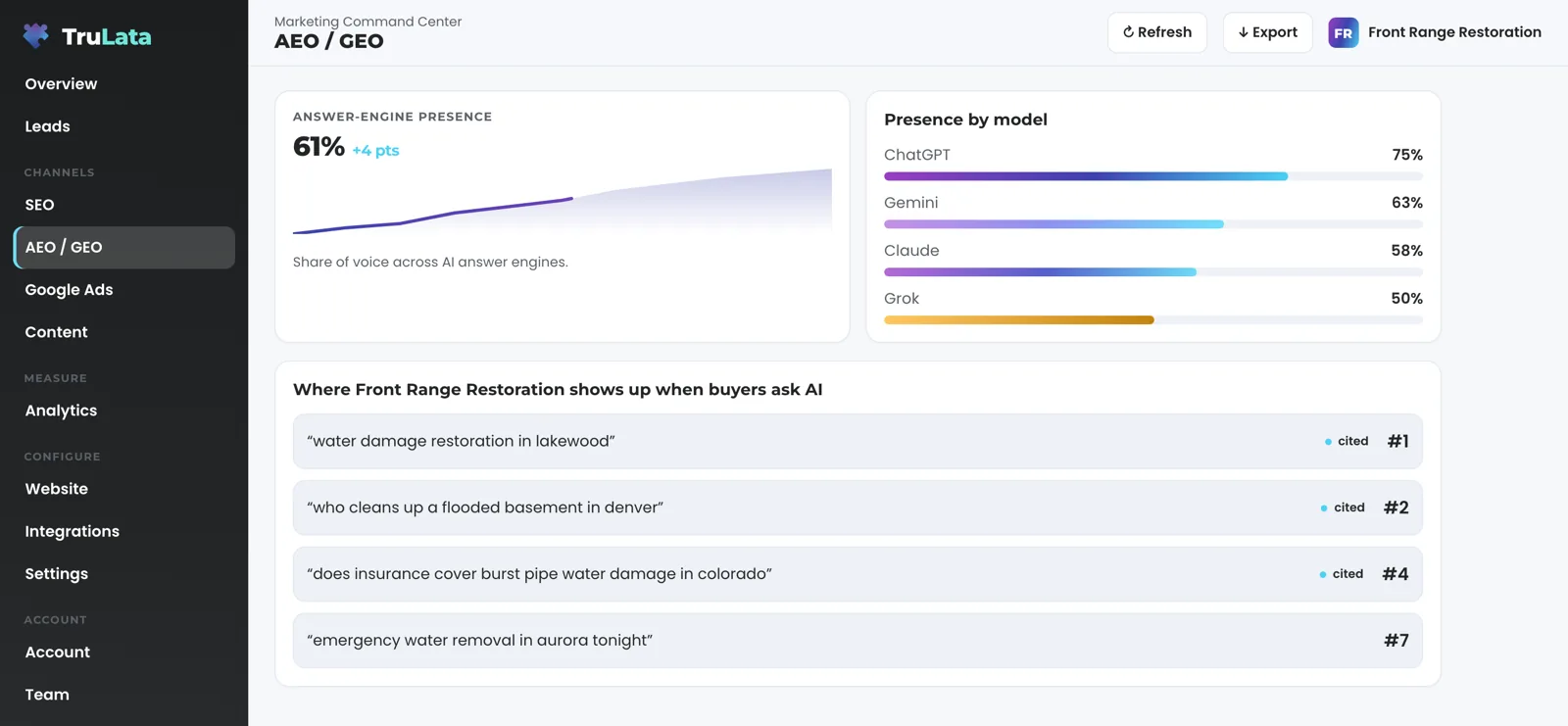
One number: the share of answers in which an engine named your business, with the change since the last run and the run's date beside it. Under it, presence by engine. Strong in one model and absent in another is a different fix from absent everywhere. Under that, the per-question table. Named or not is decided by reading the answer text for your business name. The opening of each answer stays in the run record, so your team can read who the engines named instead and bring that back to you. That is the half you can act on.
The denominator is the answers actually received. When an engine returns nothing, that blank is a measurement error and it leaves the denominator. It stays out of the score, because a blank carries no answer about you either way. Each run records how many blanks there were. The set is scored at baseline during setup and re-run as the program moves, and the view carries the date of the run it shows.
What moves the number?
The program moves it. The view reports it, and TruLata keeps the two apart. The work is the same work that moves search, applied to how an engine reads a business: facts that agree everywhere the engine looks, including your Business Profile, the directories and the review sites; pages that answer the buyer's literal question in plain words; structured data that says what you are and where you work; reviews and citations that agree with each other; and answer blocks on your own site written to be quoted, not skimmed. The trade calls this work answer engine optimization, with generative engine optimization as its near neighbour. The search and answer-engine services page describes the program. The answer-engine view says whether it worked.
The AI visibility program runs on all tiers, and the content engine on Launch, Growth and Command. The tier table has the numbers. Every topic is checked for real search volume and for what already occupies the results before it is written, the research step cites current sources, and each piece is filed as a Google Doc in your Drive. Google's AI Overviews are a generated answer too, but they sit on a results page, so the search view measures them through Search Console, two to three days behind. Every tier is month to month with nothing metered.
- Facts that agreeYour Business Profile, the directories and review sites say the same thing
- Pages that answerThe buyer's literal question, in plain words
- Structured dataWhat you are and where you work
- Answer blocksOn your own site, written to be quoted
- The viewSays whether it worked
What this use case reads, in one table.
| What | Where it comes from | How fresh |
|---|---|---|
| Questions | Written early in setup, from what buyers in your towns ask | Additions requested through your team, logged |
| Answers | ChatGPT, Gemini, Claude and Grok, each through its own API, live web search on | As of the run shown, dated on the view |
| Named or not | The answer text, read for your business name | Per run |
| Score | Answers naming you over answers received; blanks recorded and excluded | Per run, with change since the last run |
| Presence by engine | The same run, split by engine | Per run |
| Named instead | The kept opening of each answer | Per run |
| AI Overviews | Search Console, through the search view | 2 to 3 days behind, set by Google |
Every number on the view carries the date of the run that produced it, scored at baseline during setup and re-run as the program moves.
Questions, answered.
Which AI engines are asked?
ChatGPT, Gemini, Claude and Grok, each through its own API with live web search on for every question, the way the apps search, not from what the model memorised alone. Google AI Overviews are measured in the search view.
Who writes the questions?
Your team, in the second week of setup, from what buyers in your towns actually ask. The set spans the trade's phrasings and your towns on purpose.
Can I add a question later?
Yes. Send it through the keyword request on the screen or by email. The request reaches your team as a logged ticket, and your team adds it to your set for the next run.
What happens when an engine gives no answer?
The blank is recorded as a measurement error and left out of the denominator, so the score reads only the answers actually received. Each run records how many blanks there were.
How often is the score re-run?
At baseline during setup and again as the program moves. The view carries the date of the run it shows.
Which tier includes this?
The AI visibility program is on all tiers. The pricing page lists what each tier adds beyond it.
See it running
before you decide.
The demo is the real product on a fictional company, with your name and email in front of it. Pricing is three published tiers.
Open the live demo See pricing
New here? See what TruLata is. Prefer to write? Send us the one thing you want to know.
Start here: AI marketing platform · AI marketing software · all-in-one marketing platform · marketing automation software · marketing software for small business.
- Refreshed when you open itLive data on page load, never a monthly PDF
- Counted from your own formsLeads recorded server-side, compared daily with Ads and GA4
- Seen in AI answersHow often ChatGPT, Gemini, Claude and Grok name you, measured
- Every send loggedProspect emails leave from a review-first queue, and every send is logged.